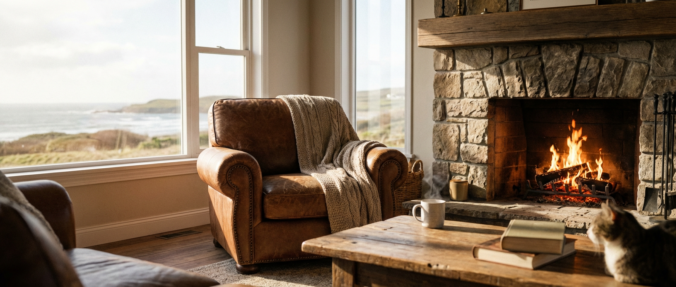
The Kitchen Table Theory
I used to think home was a place you found once and kept forever. Like a good coffee shop or the perfect pair of jeans. You’d know it when you saw it, claim it, and that would be that. For years, I carried this romantic notion that somewhere out there was my place, waiting for me to stumble upon it and feel that magical click of recognition.

The kitchen table in my childhood house had a particular smell. Not just the wood polish my mom used religiously every Sunday, but something deeper. The accumulated scent of countless dinners, homework sessions, and late-night conversations. I thought home meant finding another place that smelled exactly like that.
Turns out I was completely wrong about almost everything.

The First Crack in My Theory
It hit me in an airport bathroom in Denver. I know, I know, not exactly where you’d expect a life revelation. But there I was, washing my hands, and this weird sense of calm just settled over me. The fluorescent lighting was awful. The paper towels felt like sandpaper. Someone two stalls over was having a screaming phone fight. Yet something about that sterile, anonymous space felt familiar in a way that caught me completely off guard.
I’d been traveling for work for about six months, living out of a suitcase more than my actual apartment. All that movement should have made me feel unmoored. Instead, I found myself getting comfortable with departure gates and hotel key cards. That bathroom moment was when I first thought, “Wait, maybe my childhood theory about home is total BS.”
It wasn’t the place that felt like home. It was my own comfort with being temporarily nowhere. I’d accidentally gotten good at finding peace in transition, and that skill came with me everywhere I went.
The Library Years
Graduate school brought me to a new city and the third floor of the university library. God, that place was ugly. The carpet looked like it hadn’t been replaced since Carter was president. The chairs were this aggressive orange that some decorator in 1982 thought was “energizing.” The heating system sounded like a dying whale. But every Tuesday and Thursday afternoon, I claimed the same corner table near the philosophy stacks.
Within a month, that hideous orange chair knew exactly how my shoulders curved. The librarian would give me a little nod when I walked past. I figured out which vending machine would give you two bags of pretzels if you hit B4 just right. Tiny details, really. But they started adding up to something that felt a lot like belonging.
Here’s what caught me off guard: I wasn’t trying to recreate my childhood kitchen table experience. I wasn’t looking for anything that smelled like wood polish or felt like Sunday dinners. This was something completely new that somehow did the same job, giving me a space where I could just exist without having to explain myself or put on a show.
That’s when it dawned on me that maybe I’d been thinking about this backwards. Maybe home wasn’t about finding the right place. Maybe it was about becoming the kind of person who could recognize home when it showed up wearing unexpected clothes.
The Coffee Shop Revelation
2019 was my “great coffee shop experiment” year. I’d joined the ranks of laptop-wielding cafe nomads, partly because my apartment’s wifi was trash and partly because I’d started craving the low hum of other people’s conversations. But instead of finding one perfect spot and planting myself there forever, I started cycling through five different places.
Each one was flawed in its own special way. There was the place with incredible pastries but chairs designed by someone who clearly hated human spines. The one with perfect seating but coffee that tasted like it had been filtered through disappointment. The hipster joint where they memorized my order but cranked the music just loud enough to make thinking feel like work.
I expected all this bouncing around to feel restless and scattered. Instead, I stumbled into something better than one perfect place: the ability to feel at home in several imperfect ones. Each spot worked for different moods, different weather, different kinds of projects. I wasn’t hunting for a replacement kitchen table anymore. I was building this whole constellation of spaces where different pieces of myself could get comfortable.
The barista at the loud hipster place started saving me the good window seat when it rained. The owner of the spine-torture-chair place would let me hang out past closing if I was deep in something important. Small gestures, really. But they added up to something I hadn’t expected: multiple homes, each incomplete but real.
What I Know Now
If I could sit down with my younger self, the one convinced home was something you stumbled across and claimed forever, here’s what I’d tell her: you don’t find home, you practice it. Like learning to parallel park or make scrambled eggs that don’t turn into rubber, it’s a skill that gets better with repetition and attention.
Home isn’t about finding the perfect place with the perfect smell and the perfect lighting. It’s about getting better at creating familiarity, comfort, and belonging wherever you happen to land. Some people are naturals at this. They can walk into any room and within an hour they’ve rearranged something, learned three people’s names, and somehow convinced the space itself to bend to their energy.
The rest of us learn it the slow way. We figure out that home is something we carry around and use strategically, not something we discover fully formed in the world. That airport bathroom felt familiar because I’d gotten comfortable with temporary spaces. The library corner became home because I’d shown up consistently. Those coffee shops taught me that home could be multiple, fleeting, and still completely legitimate.
I still think about that kitchen table, but the desperate nostalgia has faded. Now I get that what made it special wasn’t the wood or the smell or even the conversations. It was that my family had practiced being together in that space until the table itself became shorthand for our shared presence.
And that’s something you can build anywhere, once you realize what you’re actually looking for.
So I’m curious: where have you found home in unexpected places? Did it make sense, or did it blindside you like that Denver airport bathroom blindsided me?
Recent Comments