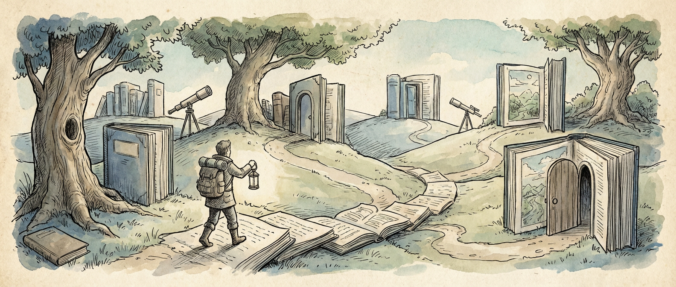
The Lies We Tell About Life-Changing Books
You know that person at book club who always mentions how “Eat, Pray, Love changed everything” for them? I used to be suspicious of those declarations. Not because I doubted their sincerity, but because the books that genuinely shifted my worldview weren’t the ones plastered on bestseller lists or clutched by people posting inspirational quotes on Instagram.

The real game-changers crept up on me. They were often books I picked up by accident, recommended by someone whose taste I normally questioned, or found gathering dust in a library corner. These weren’t the books that promised transformation in their marketing copy. They were just stories that happened to rewire something in how I saw the world.
Here’s the uncomfortable truth: the books that actually change us are rarely the ones we expect to change us. Sometimes the most dramatic shifts come from the most unlikely sources. Like a novel about a butler that made me question every excuse I’ve ever made.
“The Remains of the Day” Taught Me About Self-Deception
I picked up Kazuo Ishiguro’s novel thinking I was getting a quaint story about British manor houses. What I got instead was a brutal education in how we lie to ourselves. Stevens, the butler protagonist, spends the entire book crafting elaborate justifications for choices that were really about fear and missed opportunities.
The genius of the book isn’t that Stevens is unusually self-deceptive. It’s that he’s exactly as self-deceptive as the rest of us. Watching him construct these beautiful, logical explanations for why he never pursued love or questioned his employer’s Nazi sympathies was like looking in a funhouse mirror. Uncomfortable and distorted, but definitely recognizable.
After reading it, I started catching myself mid-rationalization. That job I stayed in too long because of “loyalty”? That friendship I maintained because of “history”? Suddenly I could hear Stevens’ voice in my own excuses. The book didn’t cure me of self-deception, but it made me more suspicious of my own internal monologue.
Nicholson Baker’s “The Mezzanine” Made Me Notice Everything
This is probably the weirdest book I’ll defend to the death. It’s 135 pages about a guy’s thoughts during his lunch break. That’s it. He thinks about shoelaces, drinking straws, the hand dryers in office bathrooms. Most people find it boring. I found it life-changing.
Baker takes the most boring details of modern life and examines them with the intensity usually reserved for great literature or scientific discoveries. He’ll spend three pages on why paper towels beat hand dryers, complete with footnotes about air velocity and bacterial transmission. It sounds insufferable. It’s actually mesmerizing.
The book trained me to pay attention differently. Now I notice the way elevator buttons wear down in predictable patterns, how people unconsciously organize their grocery carts, the specific sound of different types of paper being turned. These aren’t earth-shattering observations, but they’re mine. Baker taught me that paying close attention to anything makes it interesting.
People talk about mindfulness like it requires meditation retreats and expensive apps. Baker showed me it could start with noticing how many times you check your phone while walking from your car to the grocery store entrance. The ordinary world became exponentially more fascinating once I started really looking at it.
“The Sellout” Forced Me to Confront My Own Comfort
Paul Beatty’s Pulitzer Prize winner is a book that refuses to let you get comfortable with any position on race, politics, or American identity. It’s about a Black man who tries to reinstate slavery and segregation in his LA neighborhood as social satire. It’s hilarious and horrifying, often in the same sentence.
What changed my perspective wasn’t the book’s politics, exactly, but its complete refusal to offer easy answers or comfortable moral positions. Beatty doesn’t write victim narratives or redemption arcs. He writes about contradiction, complicity, and the ways we’re all mixed up in systems we claim to oppose.
The book made me deeply uncomfortable with my own tendency to seek out simple explanations for complex problems. It’s much easier to divide the world into good guys and bad guys than to sit with the reality that most of us are both, depending on the day and the circumstances. “The Sellout” won’t let you retreat into moral superiority or comfortable assumptions about who deserves sympathy.
Reading it felt like having every easy opinion I’d ever held gently but firmly taken away. I finished it more confused about everything but somehow more honest about that confusion.
The Books That Didn’t Work (And Why That Matters)
For balance, let me mention the books that everyone said would change my life but left me completely cold. “The Alchemist” felt like a very long fortune cookie. “Wild” made me want to lecture Cheryl Strayed about hiking preparation. “The Power of Now” sent me into fits of eye-rolling so severe I worried about permanent damage.
This isn’t because these books are bad, exactly. They’ve genuinely helped millions of people. But they didn’t work for me, and pretending otherwise would be dishonest. The books that change us are often a matter of timing, circumstance, and personal chemistry that has nothing to do with objective quality.
Maybe you need to hear about following your dreams when you’re 22 and scared. Maybe you need to read about mindfulness when you’re 35 and overwhelmed. Maybe you need a story about British butlers when you’re finally ready to examine your own capacity for self-deception. The right book at the wrong time is just another book.
I’m curious about your own unexpected literary encounters. What book caught you off guard with its impact? Was it something you picked up by accident, something that challenged your assumptions, or something that made you notice the world differently? The books that change us rarely announce themselves with fanfare, but they’re worth talking about when we recognize them.



Recent Comments