Chantelhobbs

Personal essays, notes, and ideas worth sharing.

Page 21 of 23

Why I Changed My Mind About Journaling (And Why You Should Too)

The Skeptic’s Journey

I used to roll my eyes at journaling. Hard. The whole practice seemed like navel-gazing disguised as productivity, a way for people to feel busy while accomplishing nothing meaningful. I pictured flowery notebooks filled with rambling thoughts about feelings, the kind of self-indulgent ritual that Instagram influencers pushed alongside their morning smoothie recipes.

Why I Changed My Mind About Journaling (And Why You Should Too)

Then I ran into the research. Studies started showing that regular journaling actually reduces cortisol levels and improves working memory. Not feel-good platitudes, but real, measurable changes in how your brain works. My skepticism started to crack. If something this simple could actually improve how my brain functions, maybe I was missing something important.

The evidence kept piling up. Turns out gratitude journaling has the strongest research backing of all positive psychology interventions in randomized controlled trials. This wasn’t wishful thinking anymore. It was science.

The Market Speaks Volumes

The cultural shift around journaling has been impossible to ignore. The bullet journaling movement alone has created a $200 million market in specialized stationery and planners. That’s serious money flowing toward what I once dismissed as glorified diary-keeping.

On TikTok, therapy-adjacent journaling prompts regularly pull in millions of views. Young people are hungry for tools that help them make sense of their inner lives. They’re not just watching passively either. They’re actually doing structured self-reflection as a form of mental hygiene.

Even more telling is how personal blogs are making a comeback across platforms like Substack and Ghost. People are taking their stories back from the fragmented, algorithmic chaos of social media. Long-form personal essays are finding real audiences who want authentic, thoughtful writing about actual human experience. Sites like The Marginalian long-form writing prove there’s real hunger for deep, reflective content that helps readers examine their own beliefs and assumptions.

The Science of Meaning-Making

Here’s what completely changed my mind: journaling isn’t about feelings. It’s about cognition. When we write about our experiences, we’re basically debugging our own mental software. We’re taking the messy, often contradictory stream of consciousness and organizing it into something that actually makes sense.

This process of making meaning turns out to be crucial for psychological well-being. Our brains are prediction machines, constantly trying to make sense of incoming information. When we journal, we’re helping this natural process along. We’re creating explicit models of our experience instead of letting everything swirl around in confusion.

The cortisol reduction makes perfect sense in this context. Uncertainty and confusion are stressful. When we clarify our thoughts through writing, we’re literally reducing cognitive load. The working memory improvements follow naturally. A mind that’s not struggling to process unexamined experiences has more bandwidth for everything else.

Beyond Gratitude Lists

The strongest research backs gratitude journaling, but the practice goes way beyond simple appreciation exercises. The real power lies in developing what James Clear habit building approaches call systematic self-reflection. Regular writing creates a feedback loop between experience and understanding.

I’ve found the most valuable journaling happens when I’m questioning my own assumptions. Writing forces intellectual honesty in a way that internal monologue often doesn’t. It’s harder to maintain contradictory beliefs when you’re laying them out in black and white. The act of putting things into words reveals gaps in logic that stay hidden in the echo chamber of our minds.

This is why therapy-adjacent prompts have gained so much traction. They give you structure for examining beliefs, patterns, and reactions that you might otherwise take for granted. Questions like “What story am I telling myself about this situation?” or “What evidence contradicts my current interpretation?” turn journaling into a tool for cognitive flexibility rather than just emotional expression.

The Courage to Change Course

Admitting I was wrong about journaling meant confronting my own intellectual arrogance. I had dismissed something beneficial because it didn’t fit my preconceptions about what “productive” activities should look like. The evidence forced me to update my beliefs, but that update came with a valuable lesson about staying open to new information.

The personal blog renaissance reflects this same kind of intellectual courage. People are choosing vulnerability and long-form exploration over the safety of quick takes and viral content. They’re willing to work through complex ideas in public, to model the kind of thinking that acknowledges uncertainty and accepts revision.

Starting a journaling practice doesn’t require expensive supplies or complicated systems. It requires the willingness to sit with your own thoughts long enough to examine them clearly. It means accepting that self-reflection isn’t selfish, it’s essential maintenance for a mind trying to navigate an increasingly complex world.

What beliefs have you been carrying that might benefit from closer examination? Sometimes the most transformative insights come from reconsidering the things we’ve already decided aren’t worth our time.
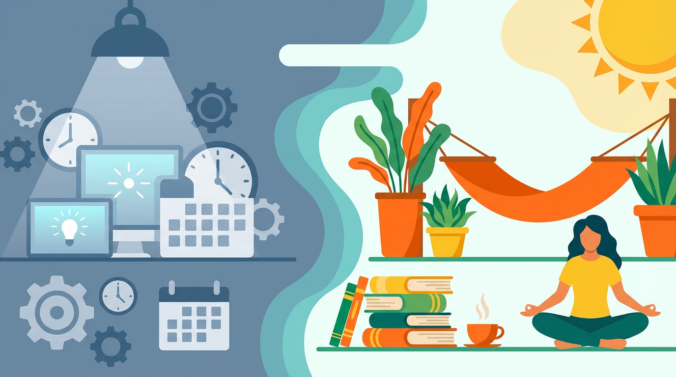
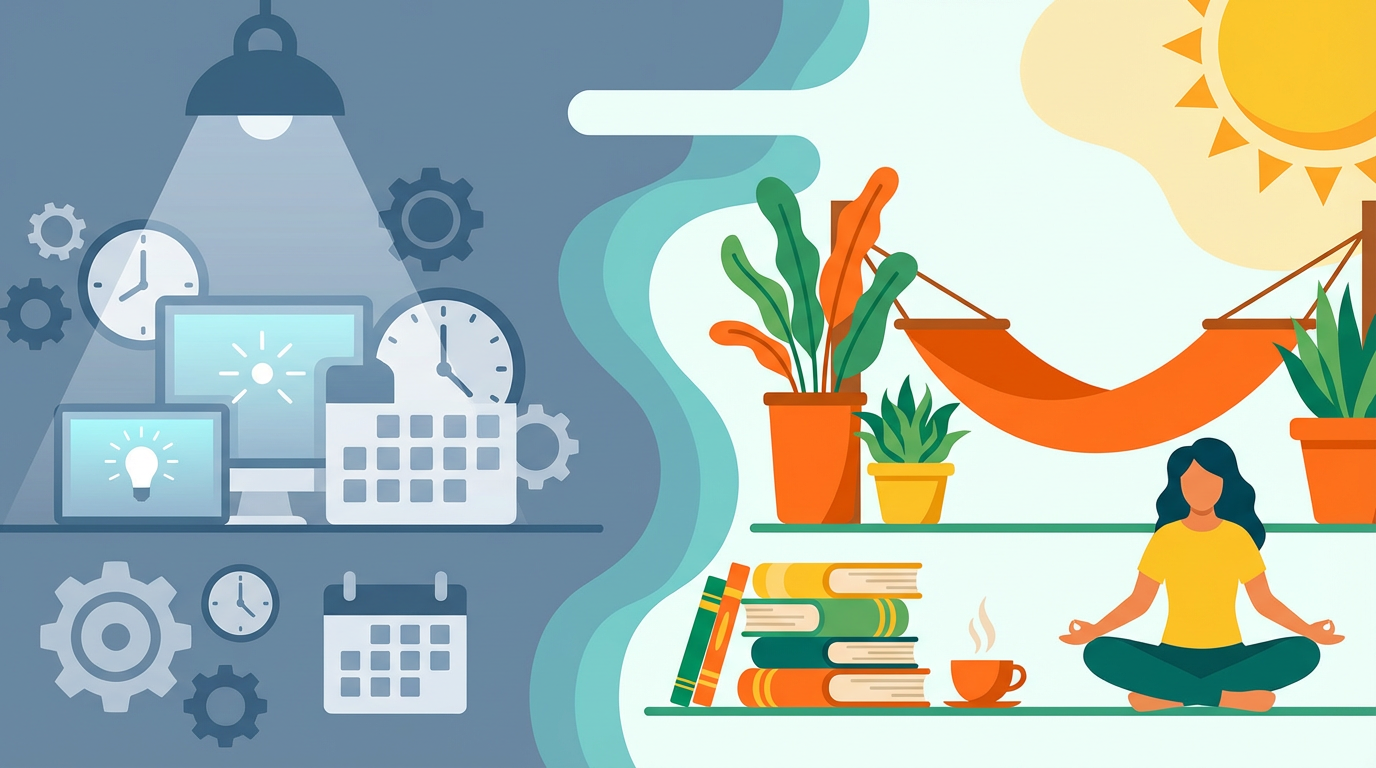
I Was Wrong About Productivity (And You Might Be Too)

The Hustle Trap I Fell Into

For years, I preached the gospel of optimization. My calendar looked like a game of Tetris, color-coded and ruthlessly efficient. I tracked everything from water intake to deep work sessions. I thought productivity meant squeezing more output from every waking hour.

I was spectacularly wrong. And based on what’s happening in workplaces worldwide, I wasn’t alone in missing the point entirely.

The productivity industrial complex sold us a lie. More tools, more systems, more hustle. But somewhere between 2022’s “quiet quitting” phenomenon and today’s ongoing workplace conversations about boundaries, something changed. People stopped buying the premise that maximum output equals meaningful work.

The Data Doesn’t Lie

The evidence against perpetual optimization keeps mounting. Studies across more than sixty companies testing four-day work weeks consistently show the same or better productivity outcomes. Workers accomplish the same amount in less time when they’re not burned out and resentful.

The World Health Organization recognized burnout as an occupational phenomenon back in 2019, giving scientific weight to what many of us felt in our bones. We weren’t lazy or weak. We were responding normally to abnormal workplace expectations.

Meanwhile, companies like Basecamp have championed anti-meeting cultures for years. Fewer interruptions, more focused work, better results. Most meetings are productivity theater, not actual productivity.

The Real Revolution Isn’t What You Think

The most interesting shift isn’t happening in boardrooms or policy papers. It’s happening in how individuals are rethinking their relationship with work and attention itself.

Personal knowledge management tools like Obsidian and Notion have exploded to millions of users. But here’s what’s fascinating: people aren’t using them to do more. They’re using them to think better. To connect ideas rather than just capture tasks.

At the same time, dopamine detox and digital minimalism movements are growing as genuine counter-culture responses to attention capitalism. People are deliberately choosing less stimulation, not more productivity hacks.

This isn’t anti-productivity. It’s pro-human productivity. The difference matters more than you might think.

What Actually Works (And What I Learned)

Real productivity isn’t about time management. It’s about attention management and energy alignment. Cal Newport productivity writing has consistently emphasized depth over busyness, and the research backs this up.

I’ve completely restructured how I approach work. Instead of cramming my calendar, I protect large blocks for thinking. Instead of responding to everything immediately, I batch communications. Instead of measuring hours worked, I track meaningful output.

The wisdom in Paul Graham essays about maker versus manager schedules finally clicked. Different types of work require different types of time. Deep creative work needs uninterrupted space, not optimized fifteen-minute chunks.

I stopped feeling guilty about saying no to meetings that have no clear purpose. I started viewing energy as my most finite resource, not time. These weren’t productivity hacks. They were sanity preservation strategies.

The New Productivity Paradigm

We’re seeing the emergence of sustainable productivity culture. It puts effectiveness over efficiency, depth over speed, and human sustainability over short-term output maximization.

This isn’t about being lazy or lowering standards. It’s about recognizing that humans aren’t machines and shouldn’t be optimized like them. The goal isn’t to eliminate all inefficiency. Some inefficiency is where creativity and relationship-building happen.

The most productive people I know today have strong boundaries, clear priorities, and the confidence to work in ways that suit their natural rhythms rather than imposed systems. They’ve rejected the premise that being busy equals being valuable.

What’s your experience been with productivity culture? Have you noticed this shift toward more sustainable approaches in your own work or workplace? I’m curious whether these ideas resonate with your experience or if you’ve found different paths toward meaningful productivity.

The Productivity Paradox: How We Learned to Stop Hustling and Start Living

The Great Unraveling of Always-On Culture

Something shifted in 2022 when “quiet quitting” entered our vocabulary. What started as a TikTok trend became a mirror reflecting our collective exhaustion with performative overwork. Four years later, the phrase still surfaces in workplace conversations, not as a fad but as shorthand for a fundamental questioning of work’s role in our lives.

The Productivity Paradox: How We Learned to Stop Hustling and Start Living

The backlash wasn’t sudden. It was a slow-burn rebellion against a decade of worshiping hustle culture. We’d been told that 5 AM wake-ups and side hustles were the path to fulfillment. Instead, we found ourselves burned out, scattered, and somehow less productive than before. When the World Health Organization recognized burnout as an occupational phenomenon in 2019, it wasn’t just medical validation. It was permission to admit the system wasn’t working.

What came next wasn’t laziness or lack of ambition. It was a realization that productivity and well-being don’t have to be enemies. Here’s the weird part: many of us got better at our jobs when we stopped trying so hard to optimize everything. I’ve watched friends become more creative and focused once they stopped tracking every minute of their day.

Illustration for The Productivity Paradox: How We Learned to Stop Hustling and Start Living

The Quiet Revolution in How We Work

While we were having heated debates about remote work, something more subtle was happening. Companies started experimenting with radical changes to how work gets done. The four-day work week went from utopian thinking to reality for over sixty organizations. The results challenge everything we thought we knew about time and output.

The data tells a story that defies conventional wisdom. Productivity stayed the same or actually improved when people worked fewer hours. Not because they crammed more into less time, but because they approached work differently. With constraints came clarity. With limits came focus.

Remember when Basecamp and Signal took their anti-meeting stance? It looked like contrarian posturing at the time. Now it seems prophetic. Teams discovered that defaulting to async communication and protecting uninterrupted work time produced better outcomes than the endless parade of “quick syncs” that had taken over our calendars. The rebellion against meeting culture wasn’t about being antisocial. It was about recognizing that collaboration and constant communication are two different things.

The Rise of Intentional Knowledge Work

As workplace culture shifted, so did our relationship with information and learning. Personal knowledge management tools like Obsidian and Notion exploded from niche productivity apps to platforms with millions of users. But this wasn’t just about better note-taking. It represented a fundamental change in how we process and retain knowledge when we’re drowning in information.

These tools appealed to people because they promised connection and synthesis rather than just storage. People weren’t collecting information anymore. They were building personal knowledge networks that matched how their minds actually work. The popularity of concepts like “building a second brain” showed a growing awareness that our relationship with information needed to be intentional, not reactive.

This shift happened alongside the growing influence of thinkers like those featured in Paul Graham essays and Cal Newport productivity writing, who argued for deep work and focused attention as competitive advantages. The message hit home because it offered an alternative to the fractured, notification-driven way most of us had been working.

Digital Minimalism as Counter-Culture

Something else was brewing in our personal lives. Dopamine detoxes and digital minimalism practices moved from fringe experiments to mainstream consciousness. What started as extreme attempts to avoid screens for days turned into more sustainable approaches to technology use.

The appeal wasn’t about rejecting technology entirely. It was about reclaiming control over our attention. People began treating their smartphones like power tools: useful for specific tasks but not something to keep running all the time. The rise of “dumb” phones as backup devices, reading apps that strip away social features, and the growing popularity of analog tools for thinking all pointed to a hunger for more intentional engagement with our digital tools.

This wasn’t nostalgic romanticism about the pre-digital era. It was a smart response to realizing that the default settings of modern technology aren’t designed for human happiness. The counter-culture wasn’t anti-technology. It was pro-human.

What We Actually Learned About Productivity

Looking back, the biggest insight wasn’t about any specific productivity technique or tool. It was recognizing that productivity is deeply personal and depends on context. The systems that work for a venture capitalist might be completely wrong for a teacher or a parent juggling multiple responsibilities.

The real breakthrough was moving away from one-size-fits-all solutions toward a more experimental, adaptive approach. People started treating productivity advice like recipes: useful starting points that need adjusting based on your ingredients, preferences, and circumstances. This led to more sustainable practices because they were built on self-knowledge rather than someone else’s rules.

Maybe most importantly, we began questioning whether optimization should even be the goal. Sometimes the most productive thing you can do is accept inefficiency for other values: creativity, relationships, rest, or simply the pleasure of doing something slowly and well.

The anti-hustle backlash didn’t make us less ambitious or less productive. It made us pickier about what deserved our energy and more thoughtful about how we spent our most valuable resource: attention. That might be the most important productivity insight of all.

What’s your experience been with finding balance between productivity and well-being? Have you noticed changes in how you think about work and efficiency over the past few years? The conversation continues as we each figure out these tensions in our daily lives.

Your Thoughts Deserve Better Than Your Notes App

Why Your Brain Is Begging You to Write Things Down

Your cortisol levels are probably higher than they need to be right now. Research shows that putting pen to paper can dial down your stress hormones while boosting your working memory. Think of journaling as a software update for your mental operating system.

Your Thoughts Deserve Better Than Your Notes App

But here’s what makes this different from the usual wellness advice. I’m not talking about forcing yourself through morning pages or documenting every mundane detail of your day. I’m talking about using writing as a tool to actually understand what’s happening in your head.

This is for people who feel like their thoughts are moving faster than they can process them. People who catch themselves having the same circular conversations with themselves. People who want to make sense of their experiences instead of just surviving them.

The Gratitude Industrial Complex Actually Got Something Right

Before you roll your eyes at another gratitude recommendation, consider this: among all the positive psychology interventions researchers have tested, gratitude journaling has the strongest evidence base in randomized controlled trials. The data doesn’t lie, even if the Instagram quotes about it make you cringe.

The bullet journaling world has created a $200 million market in specialized notebooks and planning systems. People spend serious money on dot grid pages and color-coded systems because structure helps the brain make sense of chaos. But you don’t need to buy into the aesthetic to benefit from the practice.

What works is specificity. Instead of writing “grateful for family,” try “grateful that my sister texted me the exact meme I needed to see today.” The details matter because they train your brain to notice the texture of good moments instead of just their existence.

TikTok Therapy and the Democratization of Self-Reflection

Therapy-related journaling prompts rack up millions of views on social platforms. That’s not just because people love a good mental health trend. Traditional therapy isn’t accessible to everyone, but the desire to understand yourself is universal.

These viral prompts work because they give people permission to ask themselves hard questions. “What patterns do you repeat in relationships?” “When do you feel most like yourself?” “What would you do if you knew no one was watching?” Simple questions that crack open complex inner worlds.

The beauty of journaling is that you get to be both the therapist and the client. You ask the questions and you provide the answers, at your own pace, without insurance complications or scheduling conflicts. Just like James Clear habit building principles, the key is consistency over intensity.

Reclaiming Your Story From the Algorithm

Social media taught us to package our lives into digestible highlight reels, but people are starting to crave something messier and more honest. The personal blog comeback isn’t just nostalgia for the early internet. It’s a rejection of algorithmic storytelling in favor of human-paced narrative.

Long-form personal essays are finding audiences on platforms like Substack and Ghost because readers are hungry for depth. They want to see how thoughts develop over paragraphs instead of sentences. They want to follow a mind working through a problem in real time.

This is where journaling becomes more than just self-care. It becomes practice for telling your story on your own terms. When you write regularly for yourself, you develop the muscle memory for authentic voice. You learn what you actually think, separate from what you think you should think.

Consider the way The Marginalian long-form writing weaves together personal reflection with broader cultural analysis. That kind of synthesis doesn’t happen accidentally. It develops through the daily practice of connecting your inner experience with the world around you.

Making Meaning Instead of Just Making Lists

The point isn’t to become a better person through journaling, though that might happen as a side effect. The point is to become a more conscious person. Someone who notices patterns. Someone who can trace the connection between their thoughts and their actions.

Start with ten minutes and one simple question: “What am I learning about myself right now?” Don’t worry about complete sentences or perfect grammar. Don’t worry about anyone else reading it. Just let your thoughts move from your head to the page and see what happens.

Some days you’ll write about work stress or relationship dynamics. Other days you’ll find yourself exploring childhood memories or future fears. The subject matter is less important than the practice of paying attention to your own mental weather.

Your thoughts are already happening whether you write them down or not. The question is whether you want to be a passive observer of your own mind or an active participant in making sense of it. The page is waiting whenever you’re ready to find out what you actually think about things.

What Belief update and intellectual honesty Reveals About Personal productivity and the anti-hustle backlash

Here is the thing I keep coming back to on this. The topic of personal productivity and the anti-hustle backlash deserves more careful attention than the typical coverage provides, and the reason is not complicated once you know where to look.

What I find most interesting, and I think you will too, when you look at belief update and intellectual honesty, is four-day work week trials showing productivity neutral or positive in 60+ company studies. The intellectually honest read of the situation is also the more accurate one once you examine what the evidence actually shows.

What Belief update and intellectual honesty Reveals About Personal productivity and the anti-hustle backlash

Being Honest: Setting the Terms

Quiet quitting was coined in 2022, and it’s still part of workplace conversations in 2026. This isn’t just a data point in the story of personal productivity and the anti-hustle backlash, it’s the structural condition that makes everything else in this analysis make sense. Context like this doesn’t age quickly. The conditions that produced it have been building for years, and this convergence is what makes the current moment different from previous moments that looked similar from a distance.

Four-day work week trials showing productivity neutral or positive in 60+ company studies.

Basecamp and Signal vs Noise’s anti-meeting culture is gaining traction. Paul Graham essays has been tracking this dimension consistently.

What makes this moment worth examining carefully isn’t the novelty but the confirmation. The underlying dynamics have been visible for some time. What’s new is that they’ve reached a threshold where ignoring them requires active effort rather than simple inattention. That threshold crossing is the event, not the underlying movement that produced it.

And personal knowledge management tools like Obsidian and Notion reaching millions is part of that same picture. These elements don’t exist in separate silos, they’re reinforcing conditions in the same structural shift.

The Changed Mind: The Analysis

Personal knowledge management tools like Obsidian and Notion reaching millions is where the analysis gets more specific. The surface reading is accessible and not wrong, but it misses the mechanism. And the mechanism is where the practical insight lives. What I find most interesting, and I think you will too, is that the mechanism is dopamine detox and digital minimalism movements growing as counter-culture. Understanding it changes what you do with the information.

Burnout has been recognized as an occupational phenomenon by WHO since 2019.

The skeptical counterargument deserves honest engagement: prior moments with similar surface characteristics didn’t produce the outcomes that seemed logical at the time. That history is real. What’s different now is burnout being recognized as an occupational phenomenon by WHO since 2019, which isn’t a minor variable. It’s the infrastructure condition that previous cycles lacked. Infrastructure changes tend to be persistent in ways that sentiment-driven changes are not. Cal Newport productivity writing is one source tracking this dimension with the rigor it requires.

There’s also a distributional question that often goes unaddressed in coverage of personal productivity and the anti-hustle backlash: who captures the value created by these shifts, and who absorbs the disruption costs? The aggregate picture can be positive while the distribution is uneven in ways that matter enormously to specific participants. Keeping that distributional lens in view is part of reading the situation clearly rather than just optimistically.

Implications: What This Means If You Care About Changed beliefs about work

The implications of personal productivity and the anti-hustle backlash extend beyond the immediate context. Quiet quitting coined in 2022 still resonating in 2026 workplace conversations combined with the structural conditions described above creates a situation where adjacent fields, decisions, and communities are affected in ways that aren’t always visible from inside the primary story. The second-order effects are frequently more important than the first-order ones. That’s where careful attention pays the highest returns.

Each person needs their own distinct voice, whatever that person actually sounds like.

The practical question isn’t whether to engage with these dynamics but how. The answer depends on context, on what role you occupy relative to personal productivity and the anti-hustle backlash and what your actual decision horizon is. But the first step is the same regardless: accurate understanding of what’s actually happening rather than what the most available narrative says is happening.

A few concrete observations are worth separating out from the broader analysis. First: four-day work week trials showing productivity neutral or positive in 60+ company studies isn’t a temporary condition, it’s a new baseline. Second: dopamine detox and digital minimalism movements growing as counter-culture suggests that the adjustment period isn’t over. Third, and most important: the organizations and individuals who are treating the current moment as a new steady state rather than a transition are making a categorization error that will be costly to unwind later.

The Case Against: What the Critics Get Right

Intellectual honesty requires acknowledging the strongest counterarguments, not just the weakest ones. The case against the optimistic reading of personal productivity and the anti-hustle backlash isn’t trivial. There are structural vulnerabilities in the current picture that deserve direct engagement rather than dismissal.

The most serious objection is the one about sustainability. Basecamp and Signal vs Noise’s anti-meeting culture gaining traction can be read not as a foundation but as a ceiling, a point beyond which growth becomes self-limiting because of the very dynamics that produced it. If the current state has already incorporated most of the available supply of early-adopting participants, the remaining growth curve may be structurally shallower than the recent trajectory implies.

Burnout was recognized as an occupational phenomenon by WHO in 2019.

Looking Forward

The trajectory here is clearer than the pace. Making predictions about when specific thresholds will be crossed is genuinely difficult, and anyone claiming precision about timelines should be treated with skepticism. But the direction toward quiet quitting coined in 2022 still resonating and continued development of the conditions described above is supported by the evidence in a way that doesn’t depend on a single variable going right.

Burnout being recognized as an occupational phenomenon by WHO since 2019 is the variable to watch as the leading indicator. Historical patterns suggest it moves first, with broader metrics following with some lag. This doesn’t make the outcome certain, but it makes it readable. And readability is what you need for good decisions.

Three questions are worth holding as the story develops. First: are the structural conditions that enabled the current state durable, or are they cyclical? Second: who is positioned to benefit from the next phase, and does that differ materially from who benefited in the current phase? Third: what would a clean falsification of the optimistic thesis look like, and is there any evidence of that signal emerging? These questions don’t need answers today, but having asked them changes what you notice in the months ahead.

That’s my read. I want to hear yours.

What have you changed your mind about that you’d be willing to name publicly?

« Older posts Newer posts »

© 2026 Chantelhobbs

Theme by Anders NorenUp ↑